I love Obama, yet it’s disappointing to hear about his new economic plan—namely putting some regulation back in place to protect the status quo for the biggies. Okay, he is creating a new agency for protecting financial “consumers,” which I suppose is a nicer term than “debtors.” Still, why not call it a Citizen Protection Agency?

http://www.npr.org/templates/story/story.php?storyId=105718039

Worse, he now seeks more responsibility be given to the Federal Reserve. Hey, wasn’t the Fed and its board busy meeting behind closed doors the whole time our economy “approached the brink?” For years?

For those millions of Americans losing their jobs, the economy has already gone over the brink and down a dark hole. Economist Paul Krugman, who seems controversial because he’s at least aware of this, told PBS NewsHour June 17 he wanted a stronger plan, especially on financial compensation schemes. He was countered, in the ping-pong style that often poses as “objectivity,” by a banking lobbyist.  Yet as writer Cynthia Kouril at FireDogLake points out, they agreed on one item, something I noticed, too:

Ms. Casey-Landry [the lobbyist] repeatedly made the point that major features of the financial crisis were not caused by regular banks or savings and loans, but rather by unregulated mortgage companies, or what she called “shadow banks,” and by the role of players like AIG, and by what she called “systemically significant institutions” (which I took to mean anybody deemed “too big to fail”).

See Cynthia Kouril’s article and links at http://firedoglake.com/2009/06/18/financial-re-regulation-grades-are-in-and-obamas-plan-gets-a-d/

It’s “systemically significant institutions” closely tied to the Fed to worry about. This system weighs most of us and the nation with debt impossible to pay. Who will regulate the biggest boys, who still bet on and play volatile games with currency values in international hedge funds?  They “systemically” bring nations to their knees, only “normally” it’s been other nations. (If those are any example, hyperinflation will come next.)

Kouril thinks millionaire Democrat and Speaker of the House, Nancy Pelosi, is right. We need a big investigation. Now that S.386 has passed, write to your elected representatives and help make them do it right. http://www.speaker.gov/newsroom/legislation?id=0306

While you’re at it, check out bill H.R. 1207, The Federal Reserve Transparency Act, first proposed by Ron Paul, a Republican millionaire on the far right.  http://www.govtrack.us/congress/bill.xpd?bill=h111-1207

I’ve yet to see how Paul’s retro ideas about re-establishing a gold standard for money-creation would help women “consumer” citizens, who are now being urged in TV ads to cash in their gold jewelry to pay bills. But holding the Fed accountable is a first step toward a financial housecleaning we badly need to have.

The Fed board now needn’t report out to the public what they decide at their board meetings or even who they loan billions to—given they are not really a government agency, but a system of private banks, posing as one. They create money as debt notes out of thin air. Paul wants audits at least.

On that note, William Grieder, a courageous writer, one who makes economics readable, has been critiquing a financial aristocracy for decades. He says he’s felt like “a bag lady out on the street corner, waving a placard to passing crowds.” So, hey, he relates. But now he has a new book—out from Rodale, not a NY publishing house. He believes this may be the crisis to wake us up from our slumber. If you find yourself feeling cynical and hopeless, William Grieder feels your pain, but says, Get up off your butt!

We’d better, before the thieves go on to the next robbery. Read an excerpt here and then go get Come Home, America. http://williamgreider.com/comehomeamerica

Thanks to my daughter, Kris, for this Mother’s Day article for investors in The Wall Street Journal. In it, columnist Jason Zweig advises men to share the reins to their investment portfolios with their wives. He opens with:

“Fess up, fellows: The masters of the universe have turned out to be masters of disaster. No matter which aspect of the financial crisis you consider, there is a man behind it.”

His article shows women investors tend to take fewer risks, trade less often and stick with their investments, leveraging less. He quotes psychologists who claim men are more likely to react to crises like our current one with anger, while women react with fear. That’s one way to put it, I guess.

http://online.wsj.com/article_email/SB124181915279001967-lMyQjAxMDI5NDExMTgxMTE5Wj.html

I think it more likely women understand their investments are only part of the universe. They’re well aware of how little trust should be put in arrogant men more interested in using money for self-aggrandizing sport, than in an honest return for smart investments in a future worth living. Acting with caution should only be called sensible—exactly Zweig’s point.

Warren Buffett, our country’s most famous investor, buffetts-warcalled last fall’s bank meltdown “an economic Pearl Harbor.” CNBC’s Becky Quick reminded him of this and asked him where we were, May 1st. Buffett looks like the Good-Humor Man with bodyguards, here, rattling his sword for stockholders, stating:

At that point, you could have lost the war. And there was a strike at the heart of the American system, the financial system…We got past that. Some of the right decisions were made then, so I give people great credit for doing that. The war isn’t over, though.”

Metaphors help explain what’s going on—but who exactly is the invader? Who is warring with whom? The last 30 years have seen a shameless increase in billionaires with hedge-funds, most of them “true-blue” American white males who employ CEOs. Meanwhile American wages and jobs have gone down or out of the country.

Game-players on Wall Street may love war. Winners get rich and become king of the mountain. But why should anyone fight for any king’s mountains of paper and electronic blips? Americans gave up kings when the Constitution was signed. I thought “the heart of the American system” was democracy, not “the financial system” Buffett here cites.

I am underpaid and overworked, aware of the growth in poverty around the world and among kids here at home. My adult children need 80 hours of labor to support their households, not the 40 hours my parents’ needed. Give me growing, living metaphors for any system you expect me to swallow.

Warren, make love, not war! Grow us money on trees! Dig out the cut-worms of debt. Weed out Wall Street’s witch-grass, choking out the flowering of our buzzing, living lives. I won’t rally round the flag for bogus war-mongering. I prefer what Pogo would have said about the economy last September and now:  “We have met the enemy and he is us.”

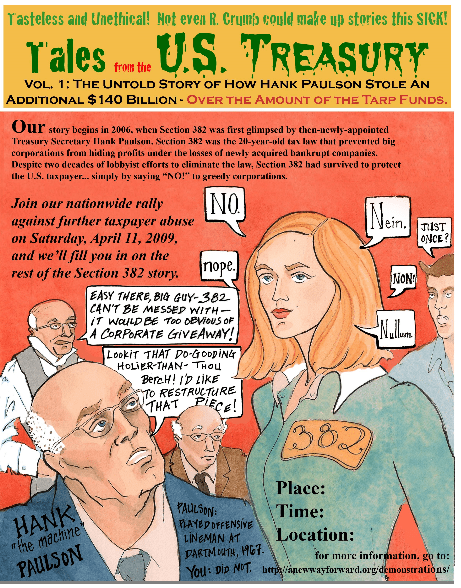
newwayfoward-protest1This is one of the posters being distributed by A New Way Forward, an organization calling for a national day of protest against CEO and Bank Bailouts on April 11th. Their website will help you discover what is happening in your area. Go out into the streets with your pitchforks and rolling pins!

http://anewwayforward.org/demonstrations/

I chose this poster,  designed by Eva Chrysanthe, because it’s so rare to see a female figure in the Investment Banking Bailout scandal.  Her No and  Section 382 refers to a tax law that was illegally overthrown last year by then-Treasurer Paulson, in a memo providing a tax windfall for his banking buddies who were already getting $700 billion from TARP.

I love the poster’s aside, commenting on women’s disadvantage: “Paulson played Defensive Lineman at Dartmouth, 1967. You: Did not.” Women aren’t at the top of the insider-clubhouse of the nation’s nine biggest banks, or at AIG and their ranks  on Wall Street are shrinking. http://www.nytimes.com/2007/12/01/business/01wall.html

It’s easy to decide the crisis has little to do with us. So why then do women always get the short end of the financial stick? (or is that dick?)

If women educated themselves about the Wall Street Meltdown and the finance culture of male one-up-manship, we might get the structural reform on Wall Street and in Washington we so badly need. Without women’s voices pressing for big change,  Obama won’t have what he needs to accomplish it.

A recent Bill Moyer interview, which I very much recommend,  presented a lawyer-banking regulator who worked on the Savings and Loan debacle back in the 80s, William K. Black. Black said the nation needs a high-profile Congressional Investigation, as happened after the Great Depression–ideally one headed by an elected woman, he added.

http://www.pbs.org/moyers/journal/04032009/profile.html

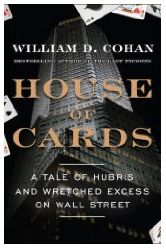
Another recent radio interview of the author of House of Cards: A Tale of Hubris and Wretched Excess on Wall Street, William Cohan, asked this former Bears and Stearn investment banker, Did he think this would have happened if some intelligent women had been part of their management team? (I missed the male interviewer’s name, but loved his asking.)  Cohan laughed and houseofcardsanswered the culture was definitely one of Alpha males gone wild.

What if a million women asked the Fed and the Treasury and all their Wall Street game-playing line-men–what on earth were you thinking? Get real!

Thanks to one of my readers who sent me these great links, in response to my groaning about our “Crisis of Credit & Stuff.” How many more bailouts and cars, American or otherwise, I asked, can our nation and Gaia withstand?

But here’s some good news on that front, an exciting new French design being tested in India, an air-powered auto, reported by BBC. Have you seen this on U.S. news?

http://video.google.com/videoplay?docid=2228669770213573581

Another Japanese prototype runs on water-even leftover tea.

http://www.youtube.com/watch?v=CrxfMz2eDME

When did we last see an ingenious idea come out of Detroit? Let’s see. The SUV, which propped up the American working man’s self-image over the past 20 years, while manufacturing jobs got shipped overseas. It was a brilliant compensation. He didn’t notice the irony of making his trucks and cars bigger, while his paycheck was shrinking, not for decades.

Oh, but these two new ecological designs would only make cars and fuel less harmful, more affordable-and where is the profit in that? How would THAT help our present GDP, a national system of accounting where disasters add up for the economy, and health doesn’t count.

So, naturally (or unnaturally, actually) both of these companies are having trouble finding financing. Duhhhhhh, as my friend put it.

credit-crisis1

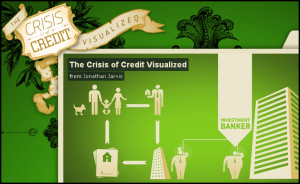
My son Keith sent me a link to a great video by Jonathan Jarvis. It helps explain in plain English why many of our mortgages are now called toxic, worldwide. He naturally has an interest, living in Las Vegas, where the real-estate market has bottomed out-or maybe it hasn’t yet.

As you’ll see, the whole credit system needs an antidote, as some international investment bankers’ “packaging” of risk (actually an exploitation of our nation’s housing) is poisoning the economic system with an overload of debt, the dark side of credit. Who are the “investors” this video talks about, who bank at international investment banks? To whom do they answer?

Crisis of Credit

http://crisisofcredit.com/

Not to us. Our nation’s leaders are quick to rescue the “big players” by our nation’s enslavement to still more debt, just as they are now moving to rescue the American dream in our car industry. Yet GM’s Rick Wagoner leaves the company with $20 million in retirement (according to ABC) after having doled out more American jobs to robots or to countries where labor is not organized to defend itself. GM now plans to cut 49,000 employees by the end of 2009. Who does Wagoner and GM’s board answer to? The same international investors Obama and Geithner answer to at The Treasury and the Federal Reserve.

The film Roger and Me explains what has long been big autos’ direction for American workers, driven by the same international investors. Some are rightly asking, who exactly will buy autos if workers, even here in the U.S., cannot afford cars? Others ask, what will happen to earth’s climate if our world fills up with more cars?

story-of-stuffSee a funny short history, Annie Leonard’s The Story of Stuff, for a clear picture of why the same economic system that doesn’t work for mortgages or us, doesn’t work for the commonwealth of our nation, or for any nation really.  It undermines Eros, the energy that charges human hearts, and it surely hurts Gaia, a healthy planet. This economy has worked, up to now, for “international investors” to whom everyone, from international corporations to nations worldwide, owes yet more borrowed and bogus paper money.

The Story of Stuff

http://www.storyofstuff.com/

One of my favorite readers wrote to pose this excellent question. Where does our money come from? Who owns the dollar? We the People-or those Chinese we keep hearing about?  Few of us really understand our dollar isn’t just issued by our government and then printed at the U.S. Mint. It is financed as a debt by the Federal Reserve System, a Banking system, and when you learn about its function and its history, you can hardly believe it. So I’ve created a new page on the subject.

In the meantime, though, take a look at your dollar bill. What does it say? Issued by the U.S. Mint? Nope. It is signed by the Treasurer of the United States, not to be confused with the second signature, the Secretary of the Treasury. Huh?  My page on the Federal Reserve explains this.

dollar-bill

Note the dollar is labeled a Federal Reserve Note. The Treasury goes to the Federal Reserve and says, hey, we need this much money to pay the nation’s bills. The Federal Reserve then writes a check whose account is never reconciled, like yours and mine, and prints up these debt-notes. Every dollar we use costs Americans a dollar plus interest, the reason for inflation and rising prices.

We pay a growing percentage of interest each year in the federal budget-and to whom? To private financiers, including some nations’ banks, who “buy” U.S. bonds, auctioned off internationally by the Federal Reserve. Like many financial terms, the “buy” part of this is misleading. These buyers are actually “loaning” us money, at an interest price determined by the Fed, a private banking system in touch with world bond and currency “markets.” How much will the market bear? How long will the Fed keep writing us checks and running up the Treasury’s credit card?

If big money, behind even Central National Banks and the IMF, is buying anything, it’s buying a piece of us. Americans are being sold into debt-slavery, similarly to other nations’ citizens who have been auctioned off before us. (See Naomi Klein’s Shock Doctrine.) What fascinates me today about currency and monetary issues is the way only the far edges of our political spectrum, both left and right, have picked it up. I can’t believe my page on the Federal Reserve recommends you watch a lecture delivered to the John Birch Society! I’m a leftie!

But in this political climate, with this media framing the issues, we must not stay confused. To Americans any “socialism” is bad, except when the rich owners of corporations or banks benefit. Yet some on both sides of the aisle are talking about the same systemic problems, however different their approaches.  Shouldn’t American women citizens understand this conversation?

Meanwhile, mainstream politics continues to leave the Federal Reserve issue completely alone. Why? Maybe because potentially, it’s incendiary.

We women, who have been encouraged not to worry our pretty little heads about the nation’s budget and big finance, are the very ones who might bridge this political gap between the far left and the far right and promote public education about the usury that threatens to bankrupt the nation. All the candidates for President in the last election were millionaires, with the exception of one, which might explain why this present system doesn’t seem to bother too many of them.

Do you know the one non-millionaire who ran?  The answer is in the middle of my new page, About the Federal Reserve. Check it out!

Thanks to my student, Elizabeth Johnson, for writing so vividly about the film by this title. I decided to view it, and then had to link it here. Falling food gets transformed in this hour-long video, from plastic food packages dropped on war-torn barren ground from an airlift, to dozens of varieties of fruit overhead in a wild garden designed by Bill Mollison. www.permaculturecairns.com/billmollisonpermaculturevideos.html

Mollison is the New Zealander who coined the word permaculture. A former logger, who noticed that none of the loggers could afford to build a house from the lumber they were felling, withdrew to a remote forest and, like Thoreau, observed nature closely. He wrote about what he discovered of inter-related ecosystems. He said the paradigm of war on nature in present-day factory farming destroyed natural relationships, endangering bio-diversity and health. When he brought his ideas forward, they caught fire. He began to design plots of land to produce foods easily with regional nature in mind. Most importantly, perhaps, his designs can even work to enliven cities and suburbs. Here’s a link to the organization rooted in his ideas. http://www.permaculture.org/nm/index.php/site/index/mollison

Mollison doesn’t say this, but he communed with Gaia and Eros. He’s a lover and shunned war-making. His passionate commitment to Gaia’s innate wisdom, a little crazy and persistent with a sexy power, overcame conventional opposition. His words woke us up to our crucial need to rediscover devotion and attention to life in all its forms–quick, before it’s too late.

My good friend, Paul Baicich, sent me this  link to a great episode on This American Life on National Public Radio. The piece  explains what’s happening to Citibank and other giants our government is bailing out with billions. It will make the hair on your arms stand on end, because you’ll UNDERSTAND it. Yikes. Thanks to TAL and writers Alex Blumberg and Adam Davidson for this – and other articles at this link.

Listening to this for 59 minutes is very much worthwhile.  Just click “full episode.”
http://www.thisamericanlife.org/Radio_Episode.aspx?episode=375

I will share this link with my seminar on Money in Literature – the same day I show the film of Shakespeare’s Merchant of Venice. Maybe I’ll throw in a little Jimmy Stewart, as George Bailey doing battle with Mr. Potter in It’s a Wonderful Life-a lovable piece of propaganda.

Ain't it wonderful?

Ain't it wonderful?

But NPR’s brave reporters didn’t touch the most blatant lie – that our network of insolvent banks borrow money from the Federal Reserve routinely – and that the Federal Reserve is itself a private network that poses as a government entity, while creating money out of thin air. Banks’ “assets,” which most assume are our deposits used to loan out, represent “liabilities” to the bank, while mortgages that create “credit” on the books (debt to YOU) are kept in motion by more air moola from the Fed. This bogus money creates debt systemically impossible to pay off. It represents 95% of the money in our economy-with only 5% issued by our government at the U.S. Mint.

The Fed also brokers our national deficit by selling t-bills that supposedly can’t go wrong, since we taxpayers will be left holding the interest-bag. The bag grew exponentially under Republicans Reagan and Bush. But even Clinton’s “balanced budget” never paid down a nickel of the principal owed-it only managed to pay the interest. So who benefits from keeping nations in debt? What are their names? That’s the sort of thing I’d like to see at Blumberg and Davidson’s blog, Planet Money.  http://www.npr.org/blogs/money/

I won’t hold my breath, not with Charles Schwab advertising on the front page. Still Planet Money is another valuable link for understanding what’s going on. Just remember what side their bread is buttered on.

Bankers like calling debt the “credit” industry and, like going through Alice’s Looking glass, it gets curiouser and curiouser in their balance sheets. But even investment banks with big players who finance nations aren’t where the real action is anymore: it’s in currency trading, where nations get regularly busted and citizens lose the value even of their currency savings-which to the banks, remember, are liabilities anyway. With a currency devalued, a whole nation can be had for a bargain.

I am a subscriber to British green-economist James Robertson’s newsletter. His clear writing about the cross-purposes of “national” financing, namely the creation of money, not by governments (only 5% in Britain and the U.S.), but by private, commercial banks as “credit,” or rather debt, clarified for me the pickle we’re continually in.

Robertson’s work in Creating New Money: Monetary Reform for the Information Age http://www.jamesrobertson.com/book/creatingnewmoney.pdf led me to American writers Tom Greco (Money), http://www.reinventingmoney.com/ Global Research http://www.globalresearch.ca/, one of their writers, Richard Cook, http://www.richardccook.com/articles.php and Ellen Brown (Web of Debt), http://www.webofdebt.com/

All of them make it clear that the Federal Reserve System is not the governmental one we all assume. Its privately owned banks are in close alliance with private firms like Citibank and Goldman Sachs, who manipulate the market to suit the purposes of those who own most of our wealth. Any doubts I had about this were removed when the first “bailout” happened, the good old boys of banking in intimate contact, helping themselves to the Treasury-with no one accountable for where the money went.

Belgian ex-banker, Bernard Lietaer, http://www.transaction.net/money/bio/lietaer.html who helped create the Euro, says roughly this about the present means of money creation: if banks create “credit” out of thin air, as they do with Federal Reserve exchanges, mortgages and business loans, where then do we the people come up with the additional money always due for their interest? Where does that additional money come from? Systemically, such a scheme must lead to ruthless competition and what Riane Eisler (The Real Wealth of Nations) http://www.rianeeisler.com/rwon.htm calls the “dominator” paradigm. Who will be king of the mountain? Who must be pushed off to win?

Now Robertson, called the grandfather of “Green Economics,” is taking some hope from the enlarging of the usual G7 or G8 meeting of nations (for the top kings) to a G20 meeting, involving more nations than any time since Bretton Woods. He has put forward monetary reform as the first order of business-nationally first, and internationally second. His ideas may still seem radical-but only because most remain ignorant of how money currently gets created. For insights into new directions we might take for a more democratic future, check out Robertson’s clearly written recommendations.

If you haven’t read about monetary reform before this, stand by to say, huh? You mean this isn’t how money gets made now? Write to your congressional delegation. Write to Obama’s economic team!

http://www.jamesrobertson.com/article/nationalandinternationalfinancialarchitecture.pdf