The lyrics from Dire Straits came to mind when I read an article about peak oil by James Howard Kunstler.  Kunstler wrote The Long Emergency and other great books  http://www.kunstler.com/and says this about American delusional thinking in the latest issue of Population Press (Fall/Winter 2008):

Years ago, U.S. negotiators at a United Nations environmental conference told their interlocutors that the American lifestyle is “not up for negotiation.” This stance is, unfortunately, related to two pernicious beliefs that have become common in the United States in recent decades. The first is the idea that when you wish upon a star, your dreams come true. (Oprah Winfrey advanced this notion last year with her promotion of a pop book called The Secret, which said, in effect, that if you wish hard enough for something, it will come to you.) One of the basic differences between a child and an adult is the ability to know the difference between wishing for things and actually making them happen through earnest effort.

The companion belief to “wishing on a star” is the idea that one can get something for nothing. This derives from America’s new favorite religion: not evangelical Christianity but the worship of unearned riches. (The holy shrine to this tragic belief is Las Vegas.) When you combine these two beliefs, the result is the notion that when you wish upon a star, you’ll get something for nothing. This is what underlies our current fantasy, as well as our inability to respond intelligently to the energy crisis.

While Kunstler is talking about energy needs, his ideas can be applied to financial realms, where “wishing on a star” and “something for nothing” are cornerstones on Wall Street and on Main Street, where bank “credit” is created out of air to become money. See Ellen Brown http://webofdebt.wordpress.com/monetary-proposal/

Kunstler and other formidable writers (including Lester Brown and Al Gore) are featured in Volume 14, Number 4, which is not yet up on the Population Press website, but it is worth a visit to see past issues as well as a scary ticker that shows population growth and the contrasting figure of arable land, which remains  static. Ouch!  http://www.populationpress.org/

President-Elect Obama’s “Remarks on American Recovery and Reinvestment” on Jan. 8, 2009, emphasized refitting America with job creation in the private sector ( public jobs like teachers, cops and firefighters mentioned briefly), along with investments in three areas: clean energy, high-tech upgrading of schools, labs and libraries, and the rebuilding of schools, roads and broadband networks. He also calls for $1000 in tax cuts for middle-class “working families.”

http://www.usatoday.com/money/economy/2009-01-08-obama-economy_N.htm

I’m most closely connected to education and so noticed his leaving out  Pell grants for college students and ignoring data that shows education and testing improves when teacher: student ratios are kept low. Instead, he proposes technology will “upgrade schools.” Yet technology, to be effective, requires more education–but education of a particular kind. We need to teach students how to think and solve problems, not merely to purchase and test out the newest money-making tools for corporations, or to entrench our dependence on finding more money to buy more technology-the same old rat trap.

We need the “vision thing,” missing since JFK and his brother Bobby-unless you want to count Reagan’s “It’s Morning in America” wishful thinking. Are Obama’s “high-tech, high-wage jobs” and competing against kids in Beijing really the best our future generation can hope for? The wind and solar power he mentions may be smarter technologies, but we have larger human questions to face about what we do with our inventions and how we measure their impacts.

As the foundation of this megalithic global economy crumbles around us, so do its unsustainable assumptions of inducing debt as the only way to grow capital. It is debt repaid by an overproduction of goods and exhaustion of our natural resources, which is also unsustainable.  We need new paradigms for reframing economic thinking and addressing our overload of debt, both our nation’s and our private ones, on a planet clearly in trouble. Monetary reform and revamping our relationship with the private Federal Reserve bank should be on the table, along with a concrete food-basket standard for stabilizing global currencies. Education for women, daycare support, and changing international birth control policy, might also help “competition.”

Most importantly, we need to make visible the economy of EROS, our human exchanges with each other and the earth. Competition can be dramatic, even fun in the short-term, but cooperation, collaboration and “paying” sustained attention is more economical in the long-term. These activities tend not to “count” in competition. Labor continues to be discounted in Obama’s economic thinking-and the “free labor” of maintaining life, including yours and your kids at home, remains invisible. Maybe Obama has a staff and Michelle to watch over such details-but most of us don’t and his $1000 tax cut splurge on the nation’s credit card won’t purchase much help.

by Jim Pavlidis

Image by Jim Pavlidis

I just lost my mother, and so have been thinking about our American way of death. You may know of a book by that title, written by muckraker Jessica Mitford in 1963, and revisited in a recent updated version. Mitford once joked about her journalistic style, “Objectivity? I always have an objective in mind.” Mitford exposed the high cost of death and the funeral business (and in other books, shamed other American businesses, like prisons).

http://www.theatlantic.com/doc/200610u/jessica-mitford

Her angle on the “biz” still fits our zeitgeist. We Americans pay little public attention to mourning and grief. It’s practically un-American not to have a nice day. I googled “death statistics,” hoping to find some indicators of the economic cost to business or government for providing leaves for a death in the family. In the U.S., is this typically paid or unpaid leave? What are the economic costs for depression associated with mourning? How many Americans have trouble taking time off from work for funerals or finding needed time for settling estates? Could we cut costs by more actively engaging in this common and necessary human process?

I couldn’t find much about the topic. Imagine the size of our silence about this. Nearly two-and-a half million people die each year, (2,425,900 in 2006, says the National Center for Health Statistics).

http://www.cdc.gov/nchs/pressroom/08newsreleases/mortality2006.htm

The NCHS press release is happy about our life expectancy rates, up from last year, now age 78, but I’m saying, what about the family impact of those 2.5 million deaths? How do we the living deal with it? Who is measuring our “private” costs? Many of those 2.5 million are not only grieved and mourned, but estates must be settled by family members or appointed others, and their deaths cost Americans a good lot of money, particularly when travel costs for today’s far-flung families get included. What is the emotional cost when that time or travel isn’t affordable?

I found the U.K. and Canada talked more openly about death, calling it “bereavement,” and apparently they’re more generous in accounting for real costs. The Department of Work and Pensions benefits pays 2000 British Pounds immediately, or $2960 in today’s currency market, to help pay for immediate bereavement expenses. Social Security pays out $500 and calls it a “death benefit.”

http://www.dwp.gov.uk/asd/asd1/bb/bb_statistics_sept04.asp

This review of SHOCK DOCTRINE originally appeared in the April 2008 issue of Vermont Woman under my byline  At the end of my review here, you’ll find links to Naomi Klein and her views on economics since publication, and a video of her if you haven’t got time to read her astonishing book.naomikleinpaperbackweb

Canadian writer Naomi Klein strikes lightening at dark corners of contemporary U.S. history with her new book, The Shock Doctrine: The Rise of Disaster Capitalism. Her work, while not easy to read, brings cathartic relief. She makes terrible sense of the worst pictures of recent America: the Twin Towers, Abu Ghraib and New Orleans’ Katrina. She lights images flashed world-wide over the past generation, ranging from the fall of East Germany’s wall to Tiananmen Square, from Walesa’s solidarity vault over a fence in Poland to the overthrow of Russia’s “White House,” from the end of apartheid in South Africa to Africa’s impoverishment.

All have economic bullying in common, an element seldom reported. Klein connects the dots between “free-market” economics and a foreign policy underpinned by the CIA and outsourced military forces, both of which exploit poverty to guard global financial interests, joining terror with yet more terror.

If this begins to sound like a conspiracy theory-it is. But it’s one the perps themselves acknowledge. These are the men who manage international trade, leverage currencies and develop economic policies of governments world-wide. They meet in the cabinet backrooms of presidencies and dictatorships around the world and apply pressure from The International Monetary Fund and the World Bank to enforce private takeovers world-wide. Klein follows this fraternity’s mind-meld, dancing in their macro-economic circles.

Klein’s tale reads like a mystery, linking two influential thinkers: the first an American psychiatrist, and the other, an economist, both with grandiose views of humanity’s need for their radical makeovers. Both were “professionals,” who used remarkably ruthless means.

Klein begins the tale with a cold war scenario close to Vermont. Former president of the American Psychiatric Association, Ewen Cameron, began experiments in the late 1950s. His institute, associated with McGill University in Montreal, sought to remake human personality, wiping the slate clean to recreate a new, improved person. An epigraph from Orwell’s 1984 aptly describes his aim, which was funded by the CIA. “We shall squeeze you empty, and then we shall fill you with ourselves.”

Cameron used electric shock methods, but far more intensely than his peers. He combined this with sensory deprivation to prevent patients from knowing time or space, as well as hallucinatory drugs, disruption of sleep patterns, messages played over and over, loud noises or padded silences. Patients were stripped of clothing or any reminders of identity and memory.

They and their families had no idea Cameron was experimenting on them. His patients “regressed” to a dependent and malleable state, transformed into frightened children. They suffered terrible long-term harm and trauma-induced physical symptoms. By the 1970s, patients and their families had exposed Cameron’s secret and brought a lawsuit against the CIA. News in the Canadian press, this case was aided by the Canadian government and finally settled by the CIA, quietly, in 1988.

The CIA got their money’s worth. Cameron’s methods became part of the agency’s KuBark manual for interrogation, which is still in use. It ultimately found its way to military training facilities and to Abu Ghraib. Wherever KuBark went, electrical wires and psychological shocks showed up.

Meanwhile in another realm, a “free-market” economist named Milton Friedman, sought to wipe more slates clean, this time to remake economics.  Friedman preached one idea for over 30 years: “Only a crisis-actual or perceived-produces real change.”  He called his economic strategies “shock treatments.”

Friedman’s methods also called for quick jolts, rapid-fire transformation: tax cuts, no-holds-barred “free trade” for international corporations, privatized contracts to replace government functions, cuts to social spending, deregulation, and increases in military budgets. The last was essential. A charismatic teacher, Friedman ultimately headed the economics department of the University of Chicago and charmed an elite male following. His students included Donald Rumsfeld, who twice became Secretary of Defense, both times under Presidents Bush. Rumsfeld called his strategy for the Iraq war, “Shock and Awe.”

Friedman’s followers called themselves “The Chicago Boys.” Like Cameron and the CIA, Friedmanites were comfortable with erasing identities, even national ones, to remake the world in their image. Economic shocks administered by governments they counseled commonly roused terror in the public, resulting in a regression similar to the patients in Cameron’s care. Strip a nation of business-as-usual, its currency, its livable livelihoods, and people regress, becoming fearful, more malleable.

Klein doesn’t say this, but I was struck by their nickname for themselves in the context of coming to power in the 1970s. The Chicago Boys seems an affectionate nickname, until you remember women’s protests of the good-old-boys-network in those days and the male-only clubiness that patronized women-as-children. Collectively American women were making grown-up demands. They wanted to be involved in economic decisions that affected their lives. They wanted a social safety net, child care and maternity leave, and government involvement in alleviating women’s poverty.

The leading economist back then, the one Friedman eventually displaced, John Kenneth Galbraith, was a Keynesian mixed-economist, who thought government should take an active role in the economy. Galbraith encouraged Marilyn Waring’s important economic critique: Who Counts: Economics as if Women Mattered. She argued reproductive and caring work of family and community, as well as Mother earth’s work reproducing clean water and air, needed to be included in our GNP (Gross National Product). It wasn’t. It still isn’t.  Macro-economists use a national accounting system that counts weapons-making an economic plus, while weapons-use and war’s destruction never counts as a minus. Wasn’t this insane, Waring asked?

The Chicago Boy’s economic methods eschewed all such questions. Weapons contracts and weapons-use became the baseline of their operations. When Friedman had his first opportunity to apply his economic shock treatments in 1975, it was no accident it happened  in Latin America, where mixed economies had been thriving, though resisting U.S. control  Who was Friedman’s first client? A military dictator named Pinochet, who had overthrown the elected President.

Friedman’s work in Chile erased economic protections and compounded the misery of Pinochet’s prisons. Yet Klein notes this first project of his was barely mentioned in any of the obituaries lauding his reputation when Friedman died in 2006. More Latin American writers understood Friedman’s “Chicago Revolution” went  hand-in-glove with the torture of protesters and their “disappearances,” and administered first in Chile, then in Argentina, Bolivia, Uruguay, Brazil and Guatemala. As Claudia Acuna, an Argentine journalist, told Klein, “Their human rights violations were so outrageous, so incredible, that stopping them became the priority. But while we were able to destroy the secret torture centers, what we couldn’t destroy was the economic program the military started and continues to this day.”

Thirty years later, Iraq would fall to a similar two-pronged shock, military and economic. I won’t attempt to describe here those more recent events but instead urge you to read the economic details yourself.

Friedman ultimately led Reaganomics’ trickle-down theories. His free-market ideology was revered by both Bush presidencies and influenced Bill Clinton in between. It’s worse than ironic that Friedman won the Nobel Prize in economics the same year that Amnesty International won it for their work with growing numbers of the tortured.  Only a few witness-writers linked the economic violence of The Chicago Boys with government killing and jailing, but the result was a “free” market enjoyed by only a few, coupled with terror for the many.

“Torture is sickening,” Klein admits, wishing she hadn’t found this connection. “It is often a highly rational way to achieve a specific goal; indeed, it may be the only way to achieve it,” the reason robbers carry guns, she remarks. Klein’s shocking claims are made the more shocking by her careful documentation.

For the Chicago Boys, elections serve as useful distractions, whatever the political theater, wherever the country, as long as economic decisions about peoples’ fates get decided by their decidedly small group. That group continues to be dominant in the global economy, having evolved to become “The Washington Consensus.” Friedman’s free-market ideologues refined their method of moving in quickly on crises and human misery, finding opportunities for shock treatments and radical change. Simply translated, their methods transferred enormous national treasuries, and the decisions about it, from the many to the few.

Near the end of his life, when Katrina had wiped out New Orleans’ infrastructure, Friedman quickly proposed (and George W. Bush quickly funded) millions of dollars be used to replace the city’s public schools with privately run “charter schools.” To Friedman, a state-run school system reeked of socialism and its overthrow was a good thing. It is highly doubtful, however, such a clean wipe of the slate for New Orleans’ schools would ever have happened in any open, democratic debate. Shocks, like Katrina and a FEMA that showed up too late, and too little, overwhelmed state and local governments to compliancy.

The Chicago Boys’ record, the Washington Consensus and its record, the global policies of the IMF and the World Bank and its statistics, all show us a world where growing numbers grow poorer and a very few grow very rich. Yet Klein ultimately ends her book on a positive note. World-wide, there’s growing resistance to the free-market’s shocks, a reason for us to hope for a better future-but only if we hold American bully-boys accountable, and only if we educate ourselves about our nation’s budget and policies.

http://www.naomiklein.org/shock-doctrine

Stocks fell again when Paulson changed the plan for that $700 billion of our tax dollars AGAIN. Market analysts say it’s the uncertainty of the Treasury “script,” this one the third change of direction.

Other federal officials just turned down a bank request to forgive 40% of credit card debt for borrowers unlikely to be able to pay. For banks, getting 60% would be better than zero. Instead Paulson urges them to give us yet more credit (translate: debt).

What’s a poor investment bank to do? Here’s a quote from an accessible overview from The Columbus Dispatch in Ohio:

Earlier yesterday, federal bank regulators issued a joint statement jawboning banks to start lending money to consumers. But Alex Merk, president of Palo Alto, Calif.-based Merk Investments, a mutual-fund firm, said that there are many factors that are making banks hoard capital.

“They don’t trust their own balance sheets, and why lend to consumers when the consumer sector is going down the drain?” he commented.

www.columbusdispatch.com/live/content/national_world/stories/2008/11/13/economy_story.ART_ART_11u-13-08_A1_C1BSD01:html?sid+101

Everywhere Paulson and his peers look, nothing appears as it seems.  People who have been trying to manage more with less have lived with this reality for a while. For the past decade, while expenses went up and jobs lost ground, I’ve wondered if the news reported was about the same economy I knew. Paulson’s meeting up with insecurity somehow seems a comfort. What exactly SHOULD we trust about an economic system that creates 98% of its currency by private bank debt? Since no one creates the added interest money that bank loans demand, someone is always left in the hole.

Most people believe our government creates our money and that the Federal Reserve, that oversees it, is a government agency.  Wrong on both counts. Surprised? I felt like Dorothy in the Wizard of Oz, reading Attorney Ellen Hodgson Brown’s substantive and well-documented book, Web of Debt. Its history and its grasp of current events makes it comprehensive, and, even better, Brown makes it readable.  You’ll learn about the Populist roots of that Frank Baum story we all thought we knew so well. It turns out the yellow-brick road was the gold bullion of bankers at the turn of the century and Dorothy’s slippers weren’t ruby slippers; they were populist silver. Technicolor made them red for Judy Garland removing the meaning of what William Jennings Bryan and his followers campaigned for.

Brown thinks it is time we finish the work they began to bring justice to national monetary policy.  Her book’s subtitle hints at solutions: The Shocking Truth about Our Money System and How We Can Break Free. The book delivers on this.  Credit, which sounds so nice, only creates more debt, but our government could create debt-free money just the way people now believe it does.  Brown also has a blog.

http://www.webofdebt.com/

Another blog with an informed view of economics you’ll recognize:

http://www.dollarsandsense.org/blog/2008

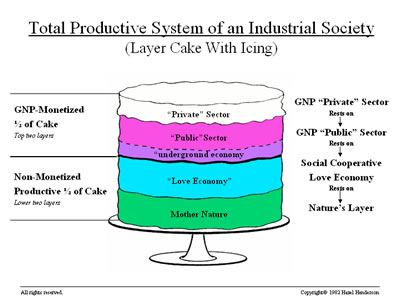
If AIG’s latest request for more bailout billions wasn’t the frosting on the cake, I’ll take the cake and eat it too. I’m referring here to Hazel Henderson’s famous economic cake that clarifies what now gets left out of the economy. You and me and our mother earth.

My pages about Gaia and Eros parallel what Hazel calls the “non-monetized” half of the economy, her two bottom layers. Without them, whatever you call them, Eros or the Love Economy, Gaia or Earth, we’d all be pretty flat. You’ll also see the monetized filling, the “underground economy,” so necessary to the addictions Barbara Brandt talks about in Whole Life Economics. What tops our present economic cake, of course, is that “private sector,” the folks who get all the frosting. Lately they’ve been helping themselves to the “public sector’s” bowl of batter too. But neither sector could sweeten a thing without the non-monetized work “the rest of us” do.

Henderson says we’ve outgrown this hierarchical paradigm. A futurist, Hazel Henderson now travels the world, speaking about a new transformative information age. http://hazelhenderson.com

totalproductivesystemindustrialsociety2

Now that the bailout is jumping out of the cake, buck-naked, (see more on this below) let’s hope this overblown economic party is close to being over. What we need is a designated driver.

Plus all of us should get a lick from that frosting spoon.
http://www.iht.com/articles/2008/11/11/business/11aig.php

We’ve been upset the past few weeks by Treasury Sec’y Paulson’s dashed-off request to Congress for $700 Billion to bailout investment banks “too big to fail.” But as an article in the International Herald recently pointed out, we hear no discussion by either Presidential candidate of the  $700 Billion forked over to the Pentagon year after year, to maintain its humongous global operations. Any Democrat’s mention of any cuts to their bloated budget leads to accusations of being unpatriotic or even not-real.

Excuse me, but $700 Billion here, $700 Billion there, it begins to add up. Can we really afford to police the world? Should we?  Money can’t make up for smarts and frequent reality-checks.

Americans didn’t die for the privilege of taking on the role of policeman.  Freedom and democracy go hand-in-hand with peace-making and enabling others’ empowerment. This is a legacy we can all celebrate, especially our soldiers–but not without the support of courageous and skillful diplomacy. We need an adequate State Department budget and the political will to use it, as Ed Carroll points out–and also checks and balances on those secret budgets of the CIA, which Carroll doesn’t mention here.

www.iht.com/articles/2008/10/06/opinion/edcarroll.php

Over the past 30 years, we’ve seen a huge movement of women and mothers into the job market worldwide. Two wage-earners were always needed in American working-class families, but you’d expect our middle-class families to be more solid as a result of this new demographic shift. Instead we’ve seen an increase in bankruptcies; we’ve seen stagnant wages failing to keep up with rising costs. I hope you’re asking, why? (More on this later.)

In just about every economic category, women come up with the short end of the stick. Their reproductive and emotional work costs them in real time and expenses, as they rear the next generation’s workforce and maintain family and community connections foundational to a working economy. Yet this work continues to be unpaid at home or underpaid when out in the job market. The crucial work of childcare and homemaking and maintaining community doesn’t even register as “economic,” though clearly it is. We wouldn’t have an economy without it. It’s time to ask ourselves, what’s this economy for anyway?

www.timeday.org/economyconference/

This problem of invisible but essential work isn’t a “women’s issue.” It affects women and men and the families from which every human has benefited. We all need care at the beginning and end of our lives–and sometimes in between. This family care would be easier if the marketplace paid women fairly. The Institute for Women’s Policy Research reports that equal pay for the average woman would contribute $5710 to her household. Imagine. Over a 35-year working life, she would gain $210,000. Would this be a bad thing for your family? www.iwpr.org/pdf/payequityrelease.pdf

By now you’ve probably heard about The Washington Post story on a University of Florida study that appears to demonstrate male chauvinists with traditional ideas about women get paid $8500 more a year than you wussy men with fair-minded views. But not so fast! Bonnie Erbe Scripps, with Howard News Service, makes this observation (among others):

“Allow me, dear reader, to step back for a moment and agree that perhaps one of the study’s conclusions is correct: Egalitarian men face pay discrimination in the same way women, whether traditional or not, apparently face it. But perhaps that can be explained away because egalitarian men, like many of their egalitarian female counterparts, don’t want to put in 80-hour weeks. Perhaps they, too, want time to fully participate in the rearing of their children? Heaven forfend: Could that explain the pay gap these authors claim to have found?”  findarticles.com/p/articles/mi_qn4188/is_ai_n28117313

I once complained to my husband, when I couldn’t find a pair of matched sox for work, “I need a wife!” He was very sympathetic, answering, “I know! I need one too!” We’re living in a wifeless world. Are you?

Most of us are bored by economics, or scared of it. Our eyes glaze over at the abstract language. When we can’t understand, we feel stupid. We turn away or get angry.

Getting angry may be the healthier response. Americans have gotten angry lately, learning about mortgage frauds and the financial wizards who sold these around the world with obscure language no one was sure they understood. Who benefits form complex financial schemes? Not you and me. We just got stuck with another $700 billion bailout for investment banks, demanded by the same Wall Streeters whose political party rails against “socialism.”

Here’s some enlightening graphs that show the phenomenal increase in the net worth of millionaires and billionaires since 1983, about the time when conservative economist Milton Friedman first influenced “neo-liberalism” worldwide. Pay special attention to the long blue bar on the right.

http:www.theglobaleducationproject.org/earth/wealth.php

The weathiest 2% now own nearly half the world’s wealth, thanks to a so-called free market that favors the “redistribution” of money upward. Friedman’s ideas influenced Reaganomics here over 20 years ago. In the days of kings, neo-liberalism used to be called laissez-faire economics. Both reject regulation and interference with the rich. However, now that the richest banks are in trouble, these same neo-liberals run to us taxpayers. Those of us who believe in a more democratic economy (like Paul Krugman, I hope) think this is a good idea–but not with a continued sense of royal privilege for CEOs and speculative investors.

Here’s a link to a quote from John Maynard Keynes, an early 20th century economist whose ideas were overthrown by Friedman: “Words ought to be a little wild, for they are the assaults of thoughts on the unthinking.”

http://krugman.blogs.nytimes.com/?8dpc